Projet portfolio individuel
Projet / Analyse de performance & Conversion
Funnel e-commerce & leviers de conversion
Problème métier
Où les utilisateurs abandonnent-ils avant l'achat ?
- Visiteurs
- 3 022 130
- Taux vue → panier
- 11,14 %
- Taux panier → achat
- 58,35 %
Problème métier
La question posée par le métier.
Ce projet portfolio examine à quel moment les utilisateurs abandonnent un parcours d'achat e-commerce et quantifie les pertes de conversion à chaque étape du funnel.
- Question
Où les utilisateurs abandonnent-ils avant l'achat ?
- Périmètre
3,02 M visiteurs · Vue → panier 11,14 % · Panier → achat 58,35 %
- Attendu
Identification du principal point de friction entre consultation, panier et achat.
- Décision visée
Tester les CTA et la visibilité de l'ajout au panier sur les pages produit
Données & méthode
Comment les données ont été préparées.
Origine des données, étapes de traitement et contrôles appliqués avant analyse.
Méthode
- 01
Définition des étapes du funnel : vue → panier → achat
- 02
Calcul des utilisateurs uniques, taux de conversion et taux d'abandon via des CTE SQL
- 03
Analyse de 3 022 130 visiteurs avec DuckDB pour des agrégations performantes
- 04
Construction d'un dashboard Tableau destiné au suivi par les équipes métiers
- 05
Isolation de l'étape vue → panier comme principal point de friction
Contrôles qualité
- 01
Logique de funnel utilisateur strictement chronologique en SQL
- 02
Contrôles de qualité des données et exports prêts pour Tableau
- 03
Classeur Tableau et capture du dashboard
- 04
Échantillon de données et méthodologie documentée
Outils mobilisés
- SQL
- Tableau
- Python
KPI
Les indicateurs suivis.
Les indicateurs retenus pour répondre à la question métier, et le reporting qui les restitue.
- Visiteurs
- 3 022 130
- Taux vue → panier
- 11,14 %
- Taux panier → achat
- 58,35 %
- Taux de conversion global
- 6,50 %
- Utilisateurs avec panier
- 336 718
- Utilisateurs acheteurs
- 196 474
Funnel e-commerce / restitution principale
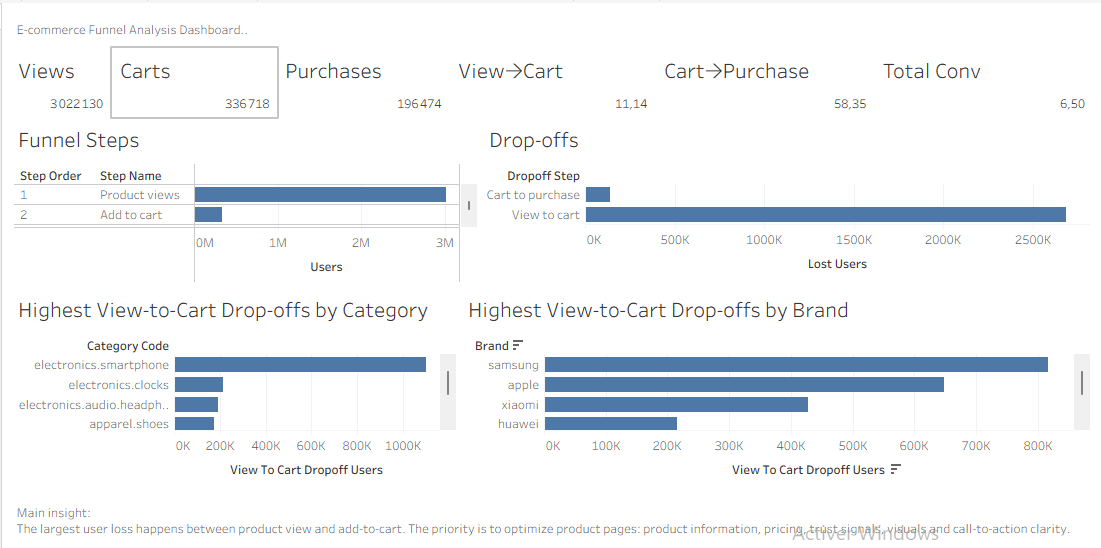
Dashboard funnel — conversion et abandon par étape
Analyse
Ce que montrent les indicateurs.
Lecture des écarts et des tendances observés dans les données du projet.
Funnel utilisateur strict
Taux panier → achat : 58,35 %- 01Entrée du funnel
Visiteurs
3 022 130 - 02Taux vue → panier : 11,14 %
Utilisateurs avec panier
336 718 - 03Taux de conversion global : 6,50 %
Utilisateurs acheteurs
196 474
Constat principal
Seuls 11,14 % des visiteurs ajoutent un produit au panier, alors que 58,35 % des paniers aboutissent à un achat. Le principal point de friction se situe donc entre la vue produit et l'ajout au panier, et non au moment du paiement.
Décision & recommandation
Ce que l'analyse change pour le métier.
Priorités et actions déduites des résultats observés.
Recommandations
Actions proposées
Les recommandations découlent des résultats de ce projet portfolio ; aucun gain testé ni impact business observé n'est revendiqué.- 01
Tester les CTA et la visibilité de l'ajout au panier sur les pages produit
- 02
Analyser les catégories de produits présentant la plus forte perte vue → panier
- 03
Mettre en place un retargeting sur les visiteurs à forte intention n'ayant pas ajouté au panier
- 04
Suivre le taux vue → panier comme KPI de conversion à part entière, au même titre que le taux d'achat
Limites
Ce que ce travail revendique — et ne revendique pas.
Origine des données, réalisation et limites matérielles restent dans le fil de lecture.
- 01Type de projet
- Projet portfolio individuel
- 02Réalisation
- Projet individuel de bout en bout
- 03Origine et périmètre des données
- Données e-commerce événementielles externes utilisées à des fins de démonstration analytique. Le jeu de données complet est exclu du dépôt en raison de sa taille ; un échantillon, les sorties agrégées et la documentation méthodologique sont fournis. Il ne s'agit pas d'une mission client.
Sources
Consulter le travail.
Dépôt, méthodologie et livrables analytiques du projet.
- 01SQL du funnel strict(ouvre un nouvel onglet)
Logique utilisateur ordonnée dans le temps : première vue, premier panier après la vue, premier achat après le panier.
- 02Contrôles de qualité des données(ouvre un nouvel onglet)
Contrôles SQL sur le volume de lignes, les types d'événements, les identifiants nuls, la plage de dates et les enregistrements exploitables.
- 03Méthodologie(ouvre un nouvel onglet)
Définitions du funnel, règles de séquencement, formules et principes d'analyse par segment.
- 04Échantillon de données événementielles(ouvre un nouvel onglet)
Échantillon CSV consultable présentant le schéma d'événements utilisé par le pipeline de démonstration.
- 05Classeur Tableau(ouvre un nouvel onglet)
Classeur Tableau connecté aux sorties analytiques générées par le projet.
Quels clients le CRM doit-il prioriser ?